

How Students Can Use AI to Learn to Write (Without Giving Away their Brains)
By Debra Ross

When KidsOutAndAbout.com surveyed parents and grandparents in November 2025 about artificial intelligence, the data told a clear story: Families know AI matters, but most don’t yet feel ready to guide their kids. Only 5% of respondents said they felt extremely confident in their understanding of AI, and a majority described themselves as only “somewhat” confident—aware of the basics, but unsure how to apply them. Even more telling, over half said they do not feel equipped to help the children in their lives understand or navigate AI at all, revealing a significant gap between awareness and readiness. Parents told us they are worried about misinformation, misuse, and the erosion of critical thinking skills—and they want practical, concrete guidance.
Many students, meanwhile, see AI as an easy path to a good grade: Just write the essay for me. That instinct is understandable, but exactly backwards. It is hard to help young people grasp that education is for them, not for a grade or a piece of paper, especially when they naturally live more in the present than the future. But the more we can help our kids imagine their future selves—and understand that giving away their thinking, whether to other people or to artificial intelligence, comes at a real cost—the more likely they are to view AI as a powerful tool to their own learning and productivity.
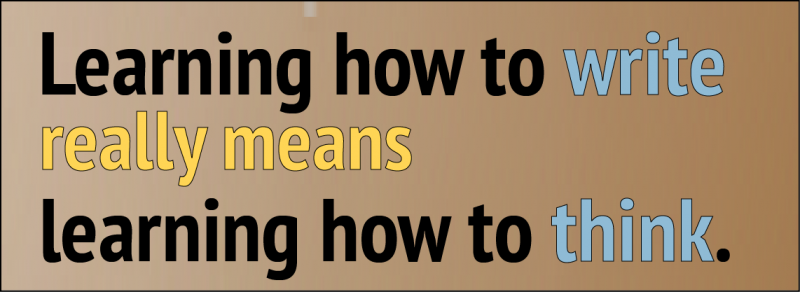
Learning how to write really means learning how to think. It's hard! But if you cede that process to artificial intelligence because it's easier than pushing through the difficult work yourself, you're sacrificing actual intelligence as part of the bargain. Decide you won't do this: Instead of letting AI spit out some pretty words and pretend they're yours, make it your writing tutor, one that is tailored to your learning style... one that asks good questions, helps students organize ideas, identifies gaps in understanding, and coaches revision, without ever taking over the work.
The rule that matters most
Before using AI for schoolwork, parents and students should agree on these basic guidelines:
The student always must be the author.
AI should never be the author.
AI's role is teacher, coach, and editorial assistant, not a replacement thinker.
If AI is producing complete answers without first asking questions, it is not teaching; rather, it is doing what it does best: generating fluent, plausible language based on patterns it has seen before. Learning happens when students struggle a bit, explain ideas in their own words, and discover what they do and don’t yet understand. When AI skips that step, the learning stops.
The goal, then, is not to avoid AI—in part, because it is gaining traction too fast in our culture for that to be possible—but to insist that it interview, challenge, and respond to the student, rather than replacing the student’s work.

CRIT Framework
AI thought leader and author Geoff Woods created a powerful yet straightforward method for using AI ethically and effectively called the CRIT Framework. CRIT stands for Context, Role, Interview, Task; it is outlined in detail in his 2024 book The AI-Driven Leader. This article shows you and your student how to use the CRIT Framework to structure a learning conversation so that the student’s thinking stays at the center as they're learning to write.
Woods typically gears his discussions to business people, but the CRIT Framework is a super-useful strategy for anyone who wants to refine their skills by using AI. Here is one strategy for applying it in essay writing:
Context
"Context" tells the AI who the student is and where they are right now. For learning, context should be rich and specific. It can include the student’s grade and age, the class and subject, what topics the class is discussing, the exact assignment, the student’s strengths and weaknesses, areas of confusion, and the ideas or instincts the student already has. The richer the context, the more precisely AI can teach—just as a good tutor adjusts to a student in real time.
Role
"Role" defines how the AI should behave. Rather than asking it to be “a teacher,” students should specify expertise: experience teaching students of a particular age, familiarity with common misconceptions in the subject, and a coaching or Socratic style that identifies gaps rather than delivering answers.
Interview
"Interview" is the safeguard against the dangers of outsourcing thinking. Here, the AI is instructed to ask questions one at a time, pause after each question, and let the student’s answers determine what comes next. Interviewing ensures that ideas come from the student rather than being inserted into the work.
Task
Only after the interview does the "task" come into play. The task defines what the AI should help the student do with their own thinking—organize ideas, clarify a thesis, strengthen reasoning, or improve clarity for an essay.

How to use CRIT in essay writing for middle school students through college
Used together, CRIT turns AI from an answer machine into a custom educational partner. First, read and think about the eight basic steps to learning how to organize your thoughts and articulate them in a way people can understand... these apply no matter what tools you're using. Then open your favorite AI interface... CHATgpt, Gemini, Claude, Co-Pilot, Perplexity, or whatever. Type "I am planning to use the CRIT Framework to help me learn to ___" Then paste in the example prompt, tailored to your needs in the instance, replacing the example context wording with your own, of course.
One super-useful aspect of AI is that you are completely free from judgment about how well you provide the prompts... you can type completely stream-of-consciousness, without proper grammar and punctuation, and the AI will sort it out. Even better, you can usually talk into your computer or phone microphone and just ramble on without need for apology or forgiveness. Whichever method (typing or speaking) works best for you, use that one, or a mixture. It takes practice for it to feel natural, but not too much. The more precisely you are able to phrase what you're trying to do, the faster you will get good results.

Eight steps to learning essay writing, and how CRIT can help in each of them
My eight steps to effective essay writing are:
Step 1: Read, then gather your thoughts
Step 2: Develop essay ideas
Step 3: Decide on a thesis for the essay
Step 4: Organize your thinking
Step 5: Draft the essay in small pieces without worrying about how well it is written
Step 6: Edit for clarity
Step 7: Strengthen reasoning, identify gaps, and fill them in (then edit into a final form)
Step 8: Reflect on what was learned
The following shows how to use the CRIT Framework for each step. (Note: I used ChatGPT to create the example prompts... after all, it's an expert in effective prompts, and it saved me lots of time from thinking up the examples myself. —DR)
Step 1: Use AI to think about what you read (not to replace reading)
Goal: Help students process books, articles, and lessons by forming their own interpretations.
Example CRIT prompt:
Context: I am a 9th-grade student in an English class reading [book/article]. The class is discussing themes, character motivation, and author choices. I understand the basic plot but am not always sure what parts matter most. I have some reactions, but they feel unorganized.
Role: Act as an expert English teacher who specializes in teaching 9th graders and understands common gaps in literary analysis.
Interview: Ask me questions one by one to determine what I understand, what I noticed, and where I’m unsure. Pause after each question and let my answers guide the next one.
Task: Help me articulate my own ideas about the reading.
Step 2: Develop essay ideas without letting AI choose them
Goal: Move from “I don’t know what to write about” to several authentic directions the student could pursue.
Example CRIT prompt:
Context: I am a 10th-grade history student writing an essay about [topic]. We’ve discussed multiple perspectives in class. I remember the material but struggle to decide what angle to take. I’m particularly interested in [student’s interests or reactions].
Role: Act as an experienced history teacher who helps students develop original arguments.
Interview: Ask me questions one by one about what interested me, surprised me, or confused me about this topic.
Task: Based on my answers, help me identify a few possible essay directions and explain what kind of argument each could support.
Step 3: Turn an idea into a clear thesis
Goal: Help students say what they actually think—and say it clearly.
Example CRIT prompt:
Context: I am an 11th-grade student working on an argumentative essay. I have an idea I want to explore, but my thesis feels vague. I know what I mean, but I’m struggling to say it precisely.
Role: Act as a writing tutor experienced in helping high school students clarify arguments.
Interview: Ask me questions one by one to uncover what I believe, why I believe it, and what evidence I think supports it.
Task: Help me formulate a clear, arguable thesis based on my answers.
Step 4: Organize thinking before writing
Goal: Teach students that structure is a thinking tool, not just formatting.
Example CRIT prompt:
Context: I have a working thesis but am unsure how to organize my supporting points logically.
Role: Act as an expert writing coach who helps students build strong essay structures.
Interview: Ask me questions one by one about what points I think support my thesis and how they relate to each other.
Task: Help me create a clear outline that reflects my thinking.
Step 5: Draft in small, thoughtful pieces
Goal: Teach writing as a process, not a one-click output.
Example CRIT prompt:
Context: I am ready to write my first body paragraph and know the point I want to make, but struggle to turn it into sentences.
Role: Act as a writing coach experienced with students my age.
Interview: Ask me questions one by one to draw out the ideas I want to include.
Task: Help me turn my answers into a clear paragraph using my own words.
Step 6: Edit for clarity without losing voice
Goal: Improve writing while preserving ownership.
Example CRIT prompt:
Context: This is a paragraph I wrote, and I’m not sure it’s as clear as it could be.
Role: Act as a skilled editor who helps students improve clarity without rewriting their work.
Interview: Ask me questions one by one about what I intended to say in each part.
Task: Point out unclear phrasing, weak transitions, or gaps in reasoning and help me fix them.
Step 7: Strengthen reasoning and identify gaps
Goal: Teach students how to evaluate their own arguments.
Example CRIT prompt:
Context: I have a full draft of my essay and think my argument makes sense, but I’m not sure where it’s weak.
Role: Act as a critical but supportive teacher experienced in evaluating student essays.
Interview: Ask me questions one by one about my evidence, assumptions, and conclusions.
Task: Help me identify where my reasoning could be clearer, deeper, or better supported.
Step 8: Reflect on what was learned
Goal: Make learning visible and transferable.
Example CRIT prompt:
Context: I have finished my essay and revisions.
Role: Act as a reflective learning coach.
Interview: Ask me questions one by one about how my thinking changed during this process.
Task: Help me summarize what I learned and how I can apply it to future writing.
Final takeaway
The future belongs to those who learn to use AI without surrendering their minds. No teacher can teach every student in exactly the way they learn best, which is why AI, used thoughtfully, can be a powerful supplement to both traditional and non-traditional education. The CRIT framework, especially Context and Interview, ensures that AI supports learning rather than replacing it, keeping curiosity, judgment, and ownership exactly where they belong: with the student.
©2025, KidsOutAndAbout.com
Debra Ross is publisher of KidsOutAndAbout.com.